Hat Toei Ngam | |
 In the past, Toei Ngam Beach was not open for tourism, so those who can enjoy this beautiful beach were just Thai Navies and their relatives. However, not only this beach has been open for visitors to enjoy, but it also provides basic facilities for this purpose. The Marine Resort, for example, is for visitors who like to stay close to the sea (But it would be better to contact the resort in advance for weekend accommodation). Although the length of this beach is about 1.5 kilometers, it does not mean that visitors can enjoy every area of it. This is because there are zones for Navy houses as well. In fact, the visitor's zone is about 300 - 400 meters. This length can support a large number of visitors, though. On weekend, this Hat Toei Ngam is alive. There are a lot more visitors than on weekend. You can see visitors go there for either swimming or a picnic. However, as just mention, on weekday, it is not suitable for backpackers who do not have their own vehicle because there are not many either public or private transports to support them, especially when they want to leave the beach. The location of Toei Ngam Beach is close to Sattahip City. If you come from Pattaya By Sukhumvit Road, it is just before the city of Sattahip (on the right-hand side). You would be able to notice its entrance because there is a tank beside the notice sign (Thai Language). | |
วันจันทร์ที่ 19 มีนาคม พ.ศ. 2555
Hat Toei Ngam

Silverlake
Silverlake Winery Pattaya | |
 The owner of Silverlake Winery is Thai ex-leading actress, named Supansa Nuangphirom. She was inspired to establish this winery after visiting several wineries in the United State. The current location of this winery, she said, was also chosen because of great advantages - near a reservoir, Khao Chi Chan, and Pattaya. Then Silverlake has constantly developed to be a Pattaya tourist attraction. After opening for tourists to visit, this winery was once promoted in the Thai TV series, named "Soot Saneha", and then Silverlake becomes very popular to Thai visitors. These days, Thai visitors, especially from Bangkok, have included Silverlake in the list of places to visit when coming to Pattaya. One of the reasons that Silverlake becomes even more interesting to visitors is spectacularly natural views. Visitors can see colorful flowers once they are at in front of the winery. They can feel the gentle breeze while walking through or seeing the very large wine yard. Khao Chi Chan which is located near the winery is presented as a great background of the view. Moreover, lots of visitors are very pleased to absolutely romantic atmosphere from the sunset on the reservoir. However, it is quite hot temperature in the afternoon, so at that time it would be better to bring a hat or whatever for protecting the sunlight. Silverlake has still been developed to attract more visitors due to adding more activities and grape-made products to encourage more visitors' satisfactory. Activities that tourists can currently do in the Silverlake are riding an ATV, horse-drawn carriage, Elephant, bicycle, and look around the yard by a round trip bus. In the case of grape-made products, there are wine, 100% grape juices, grape jam, grape pie, grape jelly, raisins, and so on. Additionally, there is a food court provided for visitors opposite to the wine yards, so visitors do not need to prepare any food before going to Silverlake. However, it also allows visitors to take their own food to picnic there. With the windmill and reservoir, it would be a good choice to picnic at Silverlake Pattaya. Visitors can go there by a metered taxi or Songthaew, but it might be too far for a motorcycle. In the case that visitors would like to go to Silverlake by their own car, visitors need to go on Sukhumvit Road to the Sattahip direction until seeing a notice sign for Khao Chi Chan on the left hand side. After turning left, just go straight away for 6 kilometers. | |
วันจันทร์ที่ 18 มกราคม พ.ศ. 2553
Hat Sai Kaeo
Hat Sai Kaeo (หาดทรายแก้ว)


Sattahip
is a beautiful beach under the supervision of the Royal Thai Navy and is near the Naval Rating School. Accommodation for tourists is provided. For more information, Tel. 0 3843 6187 Ext. 2201-2. Hat Nang Ram (หาดนางรำ) Situated close to the Sattahip deep-water port, Nang Ram beach is about 200 metres long. At the tip of the beach stands the shrine of Kromluang Chumphonkhetudomsak, the Father of Royal Thai Navy. The atmosphere is very peaceful with shadowy pine trees and lines of frangipani trees.


วันพุธที่ 23 เมษายน พ.ศ. 2551
Scuba Diving
Scuba diving
Scuba diving is swimming underwater, or taking part in another activity, while using a scuba set. By carrying a source of breathing gas (usually compressed air), the scuba diver is able to stay underwater longer than with the simple breath-holding techniques used in snorkeling and free-diving, and is not hindered by air lines to a remote air source. The scuba diver typically swims underwater by using fins attached to the feet. However, some divers also move around with the assistance of a DPV (diver propulsion vehicle), commonly called a "scooter", or by using surface-tethered devices called sleds pulled by a boat.For the history of diving, see Timeline of underwater technology.


Etymology
The term SCUBA arose during World War II and originally referred to United States combat frogmen's oxygen rebreathers, developed by Dr. Christian Lambertsen for underwater warfare. Today, scuba typically refers to the in-line open-circuit equipment, developed by Emile Gagnan and Jacques-Yves Cousteau, in which compressed gas (usually air) is inhaled from a tank and then exhaled into the water. However, rebreathers (both semi-closed circuit and closed circuit) are also self-contained systems (as opposed to surface-supplied systems) and are therefore classified as scuba.
Although the SCUBA is an acronym for "self-contained underwater breathing apparatus", usage is mainly as a normal word "scuba", it has become acceptable to refer to scuba as "scuba equipment" or "scuba apparatus" — an example of the linguistic RAS syndrome.
Scuba Diving in Pattaya and Samae San Thailand

The main scuba diving areas around Pattaya are located in what is often called the "Far Islands". These are the second ring of islands about 20-30 kilometers from Pattaya. The islands are controlled by The Navy, and no permanent structures are built there (boat traffic is also at a minimum). These islands include Koh Kin, Koh Man Wichai, Koh Keung Badaan, Koh Hu Chang and Koh Phi. Altogether there are 20 different dive sites with visibility ranging from 5 - 15 meters.
The HTMS Khram(Former USS LSM-469)
Depth to the top of the wreck 15m; depth to the sea bed=30m; visibility 5-15m; Best choice of gas is Nitrox 38
"Down she goes"
Courtesy Bangkok Post Article 1st Feb 2003
The Thai navy has sunk a decommissioned warship near Koh Phi and Koh Larn islands off Pattaya to turn it into a breeding ground for marine life. Vice-Admiral Somjai Wattanayothin, chief-of-staff of the Royal Fleet at the Sattahip naval base, said the decommissioning of HTMS Khram to was a navy project to mark His Royal Highness Crown Prince Maha Vajiralongkorn's 50th birthday.
The United States gave this ship (Former USS LSM-469) renamed HTMS Khram to the Thai Navy on the 25 May 1962. The ship, now dilapidated beyond repair, has been in use for more than 60 years. It now lies about 300 meters from Koh Phi in 30m of water.
HTMS Khram
This ship has been well prepared by the Thai Navy as a dive site, and is free from armaments, oil and most hazards to divers. Large holes have been cut in many areas and penetration dives through the ships passageways rarely takes the diver out of natural light. Care should be taken with a few of the rooms though, as big steel watertight doors are still fitted and may be locked easily with the unsuspected diver still inside.
The Bridge/Radio room
This is the highest are of the wreck. It is possible to stand on the bridge at 15m depth. all the glass has been taken out of the windows (sadly the portholes have gone too, sigh!) telegraph, steering mechanism, and any bits that may be used as spare parts have gone. Entry into the bridge area is simple and safe. A few new divers will probably have there certification cards presented to them in this room.
Deck Area and side passageways
The ship was made for carrying tanks, troops and equipment to a beach head, so the center of the boat is a large flat area with built up sides. There are several points of entry into the well lit side corridors, don't kick up the silt in them though as you swim through, else a complete silt out will occur.
Engine room
Located aft, entry via a large access hole in the middle of the load deck. again, great natural light in this area (unlike most engine rooms) Both main engines have been removed (probably to use a spare for her Thai Navy sister ship HTMS Kut). This is a great tech diving classroom, with pipes gauges and dials everywhere, though who knows how long they'll stay. Again, careful with silt in this are, as it's possible to get trapped under overhanging ledges going far under the deck.
The dive site is marked by 2 buoys at each end of the wreck.
Samae San
The Samae San/Sattahip area has similar diving conditions, with the added attraction of two large intact shipwrecks. The Petchburi Bremen is an old freighter sunk in 21 meters of water in the Khram Channel (Sattahip). It's home to many Grouper and Barracuda. The Hardeep is a cargo ship sunk in 28 meters during the World War II era. This ship is reasonably intact, and can be navigated from bow to stern entirely inside!
Hardeep Wreck
Vessels name: Supornthep, Registration: Thai, Sunk:- May 1941
* Bombed by French Aircraft during World War II during Franco/Thai Hostilities
* Powered by: 3 cylinder Coal fired engine. Single Screw
* Vessel type: Cargo ship Length/Tonnage:60meters/1000tons
* Wreck Location: N012’31.5, E100’57.5. Near Koh Chuang, Gulf of Siam
* Wreck details: Lying on its starboard side. Max depth 26 meters, with two 1000 pound bombs nearby
* There are large Bat fish that you can see on the Hardeep. They are curious by nature and like to come close to divers.
We have dived the Hardeep many, many times. Although it rests in only 28 metres of water, it can be an extremely challenging dive and for this reason we only take divers who are PADI Advanced or equivalent. Each time we dive the Hardeep we discover something new. In addition to the resident turtle, you can see Moray eels, Blue spotted rays, large Bat fish, Grouper, Barracuda and even Parrotfish!
วันพุธที่ 8 สิงหาคม พ.ศ. 2550
Pattaya/Jomtein
Pattaya lies 150km to the southeast of Bangkok,
less than two hours by road, and stretches for some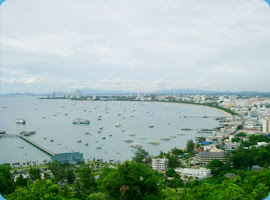
15 km along the Eastern Seaboard. Thailand's largest resort,
it shares the coast with traditional fishing villages, other resorts such
as Bang Saen and Rayong, new industrial centres, the towns of Chonburi
and Sri Racha, and the port and naval base of Sattahip. Pattaya Beach is a palm-
fringed, sandy bay with a view of coral islands on the horizon. Nearby are other
cliffs and other bays, while inland, the region is rich in agricultural products including
sugar cane, tapioca, rubber, and fruit trees.
The Vietnam War saw the start ofPattaya's international reputation,or the fledgling resort was used asan official R&R centre for the US forces.
They were flown into U-Tapao Airport which was built for American use at the time,
and shops, services, bars and hotel accommodation grew to meet the demand.
Pattaya is now a city in its own right,with its own mayor and its ownadministration. This is not all due totourism. The government developmentprogram for the Eastern Seaboard hastransformed the region and this rapidindustrial and commercial expansionhas led to many expatriates coming tolive in the area. There is a new deep-sea port at Laem Chabang, 20 kmnorth of Pattaya with a vast industrialestate and another development zoneat Map Ta Phut near Rayong to thesouth.
Pattaya City is well located to be a major business centre serving these two giant
industrial communities. There are five international schools and four international
hospitals in the area.
Fun for all:
As a beach resort with city status, Pattaya has something for everyone. Whereas
most other beach resorts rely simply on natural surroundings for their charm,
Pattaya makes an all out attempt to provide the best of everything. There is just
about everything you can think of for recreation, entertainment, sightseeing and
fun. Pattaya can be whatever you want it to be. Such is it variety that it is ideal for
all kinds of visitors. While there is plenty to keep the children happily occupied,
there is also everything for the sports enthusiastic, for couple of all ages seeking
rest and relaxation and for those who are simply looking for warm sunshine.
After dark options include open-air bars, nightclubs, cabaret shows and discos. The
nightlife centre is South Pattaya, popularly known as "The Strip". but if this is a trifle
brash and noisy for some tastes, there are alternative quieter spots for evening fun
in a more relaxed style. Shopping too, can be an evening attraction. Most
establishments close late and the dedicated bargain hunter can find all of
Thailand's best buys - silk, gems and jewellery, tailor made clothing, handicrafts
and more.
Business Venue:
Pattaya is increasingly popular venue for international conventions, conferences
and seminars. Several of the larger hotels are fully equipped to host meetings or
receptions for a thousand of more people, and even smaller properties off a range
of well appointed function rooms. Complementing the luxury of sheer space is a
comprehensive selection of state-of-art equipment for audio-visual presentations
and other conference related activities.
Accommodation:
Pattaya boasts an incredible choice of accommodation to suit every pocket.
Facilities range from luxury hotels with private beaches to bay-side hotels and
bungalows and inland economy class hotels and guest houses.
Getting There:
The easiest and most popular way to reach Pattaya is by bus. From the Eastern
Bus Terminal (Ekamai) on Sukhumvit Road in Bangkok, there are departures every
30 minutes by air conditioned bus from 5 am until 10 pm. The one-way fare is Bt
100. From the Northern Bus Terminal (Morchit II) there are departures again every
30 minutes from 5 am to 7 pm with a one way fare of Bt 105. Few visitors to
Pattaya are aware that the city does have a railway station. It is north of
Sukhumvit Rd close to Siam Country Club. One train a day leaves Bangkok's
Hualamphong station at 7 am and takes up to five hours to reach Pattaya stopping
at many stations along the way. U-Tapao, which is located near Sattahip, has very
few scheduled flights. Most visitors travelling this way are on chartered flights.
Alternatively for those who prefer to arrive with more comfort and style, Taxies and
limos are available direct from the Bangkok airport 24 hours a day.
Getting Around:
For getting around the main bay area, the minibuses and baht buses charge a flat
fare of Bt 10. The run to Naklua is also Bt 10 and to Jomtien Bt 30. Drivers usually
ask for Bt 40 to travel up the hill to Royal Cliff Beach Resort. Motorcycle hire will cost
you between Bt 150 and Bt 700 a day, depending on size. Be very confident of your
ability to handle the bigger bikes, including your skill in taking swift evasive action.
Wear a crash helmet. A jeep from a beachside vendor is about Bt 1000 a day.
Check that you have enough gasoline in the tank to get yourself to the nearest
filling station and satisfy yourself that the brakes are sharp. You will not be asked
to show your driving license, but most of these beachside hire places will ask that
you deposit your passport with them. Ask where they are going to keep it because
it may simply be placed in the attendants pocket or houlder bag and travel around
with him. Bicycles can be hired from beachside vendors at Bt 100 a day or Bt 20 an
hour. If you prefer to drive reputable vehicles with full insurance cover, and it is
strongly advised, Pattaya has a choice of car rental companies. Two leading names
are Budget Car and Truck Rental at Thip Plaza and Avis which is located at the Dusit
Resort in North Pattaya. In addition to international standards of service, these
companies will also offer you special deals, tour ideas, maps and other attractions
to make your stay easier. If you prefer not to self drive you can hire cars with
drivers to drive you to the destination of your choice for an agreed upon price.
Climate:
Pattaya has three seasons. November to February, when it's hot; March to May,
when it's hot and humidl and June to October, when it's hot and wet.
Clothing:
Dress as lightly as possible. Because of the heat and humidity, man-made fibres are
not recommended. Pack some cool cottons, and if you find that you are changing
your clothes at an alarming rate you will be able to buy locally made clothing very
cheaply. Shorts and sandals are the usual daytime wear. In hotels and more
upmarket restaurants, wear smart casual. If visiting a temple the usual dress rules
apply; gentlemen, no shorts please, and long sleeves are preferred; ladies, no
shorts, short skirts, or halter-tops.
Post and Telecommunications:
The Post Office and international telephone office are together in South Pattaya on
Soi 15, known to all as Soi Post Office. There are several private run long-distance
phone centres, most notably along Beach Road. These will be slightly more
expensive than the government service.
Internet Services:
As in Bangkok, the number of internet cafes seems to increase every week. Most
will post their rates in the window, and as competition is intense the prices are
invariably low.
Health and Safety:
Never drink tap water, and don't even gargle with it. Always use bottled water,
which is readily available and inexpensive, particularly if you choose a local brand.
The sun is strong, even during the rainy season and when there is cloud cover, so
use a good sunscreen and limit your exposure time. Malaria is no threat, but
mosquito bites can be a major irritant. Seafood is mostly caught locally and is of
high quality, but given the spicy ingredients to almost any meal, the occasional
upset stomach is a possibility. The most likely way of slowing down your vacation is
by having an accident, so watch your step when crossing the road, even (or
especially) at traffic lights and pedestrian crossings. Medicines for minor ailments
are readily available at the many drug stores in the city, and high standard of
medical treatment for more serious problems can be expected from most of the
clinics and hospitals. General ractitioners, dentists, opticians and pharmacies are
readily available.
Each of the private hospitals has its own ambulance service and 24-hour mergency
facilities. Most medical specialties are represented: neurology, orthopedics,
obstetrics, gynecology, pediatrics, internal medicine, surgery, urology, dentistry.
Cardiac patients will usually be referred to Bangkok. Note that an ambulance
is not routinely called in the event of an automobile accident, and if you require
assistance from the government service a Thai speaking person should dial 191 in
Pattaya or 193 on the highway to arrange an ambulance service.
For information and advice, the Tourism Authority of Thailand (TAT) Central Office:
Region 3 (Pattaya) is open seven days a week throughout the year, including public
and national holidays, from 8:30am until 4:30pm. Tel (038) 428 750 or 429 113.
Residents and Lifestyles:
Pattaya has many expatriate residents, and is essentially an international tourist
resort and expanding city, so the Thai population is itself very internationalised.
Most notices are in English as well as Thai, and you will find plenty of signboards in
German and even Russian. Most vendors are used to non-Thao speakers and are
ready with at least a smattering of English or German, vigorous miming, a smile,
and an ever-ready calculator. Few of the Thai residents can claim to be natives of
the locality. Even so, they haven't abandoned their traditional culture, and beneath
the glossy city veneer you will still find evidence of underlying ethnic beliefs and
customs.
Action Attractions:
Pattaya is one of the oldest diving centres in this part of Asia. It has a year-round
diving season with good visibility, the waters have a mean temperature of 28
degrees C, and there is a rich variety of marine life and coral. There are also two
wreaks which experienced divers can explore: The Bremen, a 300-foot boat, lies
upright in 24 meters of water off the Thai navy town of Sattahip, while the
freighter Hardeep rests in 30 meters of water in a channel between two islands off
Samae San, not far from Sattahip. Pattaya offers a wide choice of well-stocked and
safe PADI and NAUI operators, with competitive prices and deals. Most of them
have offices along the waterfront. Costs average at about 1,500 baht per day,
including transportation, food and equipment. Visitors can windsurf, water ski,
sea walk, swim, sunbath, snorkel, sail, or take trips to offshore coral islands. They
can rent water scooters to explore Pattaya Bay, and motorcycles and jeeps to
explore neighbouring beaches such as the increasingly popular Hat Chom Thian just
south of Pattaya. Tennis enthusiasts can enjoy themselves at the courts of leading
hotels. Further entertainment includes bowling alleys, snooker halls, shooting
galleries and archery.
Attractions outside Pattaya City:
Pattaya Elephant Village is on the road to Siam Country Club Golf Course. The
elephants displaying their forestry skills, perform cute tricks, and even play football.
Daily showtime is 14:30pm. Panarak Park is on the road to Siam Country Club Golf
Course, and has a tropical garden setting. The park is equipped with fishing gear
and a well-sticked lake. There is also bungalow accommodation, restaurants,
jogging and cycling paths, boating and water-cycling. Bira International Circuit
located at KM14 on Route 36 to Rayong, offers international motor and motorcycle
racing. The 2.4 kilometre is ideal for formula 3 races. If you want to experience
speed, the circuit is open everyday. Hat Chom Thian, located 2 kilometres from
South Pattaya, is good for swimming. The beach has become popular for water
sports and activities because it has a long straight coastline and there are less
boats anchored in the area. Pattaya Park is between South Pattaya and Hat Chom
Thian, and is a water amusement park with water slides, whirlpools and a large
pool for children. Open from 9:00 - 18:00 hrs. Nong Nooch Village is about 15 km
from South Pattaya, and is a Thai village style recreation park.
less than two hours by road, and stretches for some
15 km along the Eastern Seaboard. Thailand's largest resort,
it shares the coast with traditional fishing villages, other resorts such
as Bang Saen and Rayong, new industrial centres, the towns of Chonburi
and Sri Racha, and the port and naval base of Sattahip. Pattaya Beach is a palm-
fringed, sandy bay with a view of coral islands on the horizon. Nearby are other
cliffs and other bays, while inland, the region is rich in agricultural products including
sugar cane, tapioca, rubber, and fruit trees.
Pattaya in the 1960s was just a little fishing village, until a few Bangkokresidents began to take their eekendshere and generated a modest localtourist industry. Even so, the only hotelof any size was the Nipa Lodge; otheraccommodation tended towards holiday bungalows and beach huts.
The Vietnam War saw the start ofPattaya's international reputation,or the fledgling resort was used asan official R&R centre for the US forces.
They were flown into U-Tapao Airport which was built for American use at the time,
and shops, services, bars and hotel accommodation grew to meet the demand.
Pattaya is now a city in its own right,with its own mayor and its ownadministration. This is not all due totourism. The government developmentprogram for the Eastern Seaboard hastransformed the region and this rapidindustrial and commercial expansionhas led to many expatriates coming tolive in the area. There is a new deep-sea port at Laem Chabang, 20 kmnorth of Pattaya with a vast industrialestate and another development zoneat Map Ta Phut near Rayong to thesouth.
Pattaya City is well located to be a major business centre serving these two giant
industrial communities. There are five international schools and four international
hospitals in the area.
Fun for all:
As a beach resort with city status, Pattaya has something for everyone. Whereas
most other beach resorts rely simply on natural surroundings for their charm,
Pattaya makes an all out attempt to provide the best of everything. There is just
about everything you can think of for recreation, entertainment, sightseeing and
fun. Pattaya can be whatever you want it to be. Such is it variety that it is ideal for
all kinds of visitors. While there is plenty to keep the children happily occupied,
there is also everything for the sports enthusiastic, for couple of all ages seeking
rest and relaxation and for those who are simply looking for warm sunshine.
After dark options include open-air bars, nightclubs, cabaret shows and discos. The
nightlife centre is South Pattaya, popularly known as "The Strip". but if this is a trifle
brash and noisy for some tastes, there are alternative quieter spots for evening fun
in a more relaxed style. Shopping too, can be an evening attraction. Most
establishments close late and the dedicated bargain hunter can find all of
Thailand's best buys - silk, gems and jewellery, tailor made clothing, handicrafts
and more.
Business Venue:
Pattaya is increasingly popular venue for international conventions, conferences
and seminars. Several of the larger hotels are fully equipped to host meetings or
receptions for a thousand of more people, and even smaller properties off a range
of well appointed function rooms. Complementing the luxury of sheer space is a
comprehensive selection of state-of-art equipment for audio-visual presentations
and other conference related activities.
Accommodation:
Pattaya boasts an incredible choice of accommodation to suit every pocket.
Facilities range from luxury hotels with private beaches to bay-side hotels and
bungalows and inland economy class hotels and guest houses.
Getting There:
The easiest and most popular way to reach Pattaya is by bus. From the Eastern
Bus Terminal (Ekamai) on Sukhumvit Road in Bangkok, there are departures every
30 minutes by air conditioned bus from 5 am until 10 pm. The one-way fare is Bt
100. From the Northern Bus Terminal (Morchit II) there are departures again every
30 minutes from 5 am to 7 pm with a one way fare of Bt 105. Few visitors to
Pattaya are aware that the city does have a railway station. It is north of
Sukhumvit Rd close to Siam Country Club. One train a day leaves Bangkok's
Hualamphong station at 7 am and takes up to five hours to reach Pattaya stopping
at many stations along the way. U-Tapao, which is located near Sattahip, has very
few scheduled flights. Most visitors travelling this way are on chartered flights.
Alternatively for those who prefer to arrive with more comfort and style, Taxies and
limos are available direct from the Bangkok airport 24 hours a day.
Getting Around:
For getting around the main bay area, the minibuses and baht buses charge a flat
fare of Bt 10. The run to Naklua is also Bt 10 and to Jomtien Bt 30. Drivers usually
ask for Bt 40 to travel up the hill to Royal Cliff Beach Resort. Motorcycle hire will cost
you between Bt 150 and Bt 700 a day, depending on size. Be very confident of your
ability to handle the bigger bikes, including your skill in taking swift evasive action.
Wear a crash helmet. A jeep from a beachside vendor is about Bt 1000 a day.
Check that you have enough gasoline in the tank to get yourself to the nearest
filling station and satisfy yourself that the brakes are sharp. You will not be asked
to show your driving license, but most of these beachside hire places will ask that
you deposit your passport with them. Ask where they are going to keep it because
it may simply be placed in the attendants pocket or houlder bag and travel around
with him. Bicycles can be hired from beachside vendors at Bt 100 a day or Bt 20 an
hour. If you prefer to drive reputable vehicles with full insurance cover, and it is
strongly advised, Pattaya has a choice of car rental companies. Two leading names
are Budget Car and Truck Rental at Thip Plaza and Avis which is located at the Dusit
Resort in North Pattaya. In addition to international standards of service, these
companies will also offer you special deals, tour ideas, maps and other attractions
to make your stay easier. If you prefer not to self drive you can hire cars with
drivers to drive you to the destination of your choice for an agreed upon price.
Climate:
Pattaya has three seasons. November to February, when it's hot; March to May,
when it's hot and humidl and June to October, when it's hot and wet.
Clothing:
Dress as lightly as possible. Because of the heat and humidity, man-made fibres are
not recommended. Pack some cool cottons, and if you find that you are changing
your clothes at an alarming rate you will be able to buy locally made clothing very
cheaply. Shorts and sandals are the usual daytime wear. In hotels and more
upmarket restaurants, wear smart casual. If visiting a temple the usual dress rules
apply; gentlemen, no shorts please, and long sleeves are preferred; ladies, no
shorts, short skirts, or halter-tops.
Post and Telecommunications:
The Post Office and international telephone office are together in South Pattaya on
Soi 15, known to all as Soi Post Office. There are several private run long-distance
phone centres, most notably along Beach Road. These will be slightly more
expensive than the government service.
Internet Services:
As in Bangkok, the number of internet cafes seems to increase every week. Most
will post their rates in the window, and as competition is intense the prices are
invariably low.
Health and Safety:
Never drink tap water, and don't even gargle with it. Always use bottled water,
which is readily available and inexpensive, particularly if you choose a local brand.
The sun is strong, even during the rainy season and when there is cloud cover, so
use a good sunscreen and limit your exposure time. Malaria is no threat, but
mosquito bites can be a major irritant. Seafood is mostly caught locally and is of
high quality, but given the spicy ingredients to almost any meal, the occasional
upset stomach is a possibility. The most likely way of slowing down your vacation is
by having an accident, so watch your step when crossing the road, even (or
especially) at traffic lights and pedestrian crossings. Medicines for minor ailments
are readily available at the many drug stores in the city, and high standard of
medical treatment for more serious problems can be expected from most of the
clinics and hospitals. General ractitioners, dentists, opticians and pharmacies are
readily available.
Each of the private hospitals has its own ambulance service and 24-hour mergency
facilities. Most medical specialties are represented: neurology, orthopedics,
obstetrics, gynecology, pediatrics, internal medicine, surgery, urology, dentistry.
Cardiac patients will usually be referred to Bangkok. Note that an ambulance
is not routinely called in the event of an automobile accident, and if you require
assistance from the government service a Thai speaking person should dial 191 in
Pattaya or 193 on the highway to arrange an ambulance service.
For information and advice, the Tourism Authority of Thailand (TAT) Central Office:
Region 3 (Pattaya) is open seven days a week throughout the year, including public
and national holidays, from 8:30am until 4:30pm. Tel (038) 428 750 or 429 113.
Residents and Lifestyles:
Pattaya has many expatriate residents, and is essentially an international tourist
resort and expanding city, so the Thai population is itself very internationalised.
Most notices are in English as well as Thai, and you will find plenty of signboards in
German and even Russian. Most vendors are used to non-Thao speakers and are
ready with at least a smattering of English or German, vigorous miming, a smile,
and an ever-ready calculator. Few of the Thai residents can claim to be natives of
the locality. Even so, they haven't abandoned their traditional culture, and beneath
the glossy city veneer you will still find evidence of underlying ethnic beliefs and
customs.
Action Attractions:
Pattaya is one of the oldest diving centres in this part of Asia. It has a year-round
diving season with good visibility, the waters have a mean temperature of 28
degrees C, and there is a rich variety of marine life and coral. There are also two
wreaks which experienced divers can explore: The Bremen, a 300-foot boat, lies
upright in 24 meters of water off the Thai navy town of Sattahip, while the
freighter Hardeep rests in 30 meters of water in a channel between two islands off
Samae San, not far from Sattahip. Pattaya offers a wide choice of well-stocked and
safe PADI and NAUI operators, with competitive prices and deals. Most of them
have offices along the waterfront. Costs average at about 1,500 baht per day,
including transportation, food and equipment. Visitors can windsurf, water ski,
sea walk, swim, sunbath, snorkel, sail, or take trips to offshore coral islands. They
can rent water scooters to explore Pattaya Bay, and motorcycles and jeeps to
explore neighbouring beaches such as the increasingly popular Hat Chom Thian just
south of Pattaya. Tennis enthusiasts can enjoy themselves at the courts of leading
hotels. Further entertainment includes bowling alleys, snooker halls, shooting
galleries and archery.
Attractions outside Pattaya City:
Pattaya Elephant Village is on the road to Siam Country Club Golf Course. The
elephants displaying their forestry skills, perform cute tricks, and even play football.
Daily showtime is 14:30pm. Panarak Park is on the road to Siam Country Club Golf
Course, and has a tropical garden setting. The park is equipped with fishing gear
and a well-sticked lake. There is also bungalow accommodation, restaurants,
jogging and cycling paths, boating and water-cycling. Bira International Circuit
located at KM14 on Route 36 to Rayong, offers international motor and motorcycle
racing. The 2.4 kilometre is ideal for formula 3 races. If you want to experience
speed, the circuit is open everyday. Hat Chom Thian, located 2 kilometres from
South Pattaya, is good for swimming. The beach has become popular for water
sports and activities because it has a long straight coastline and there are less
boats anchored in the area. Pattaya Park is between South Pattaya and Hat Chom
Thian, and is a water amusement park with water slides, whirlpools and a large
pool for children. Open from 9:00 - 18:00 hrs. Nong Nooch Village is about 15 km
from South Pattaya, and is a Thai village style recreation park.
“Loi Krathong”
| ||
 | ||
The Loi Krathong Festival is celebrated nationwide in Thailand, especially where | ||
สมัครสมาชิก:
บทความ (Atom)